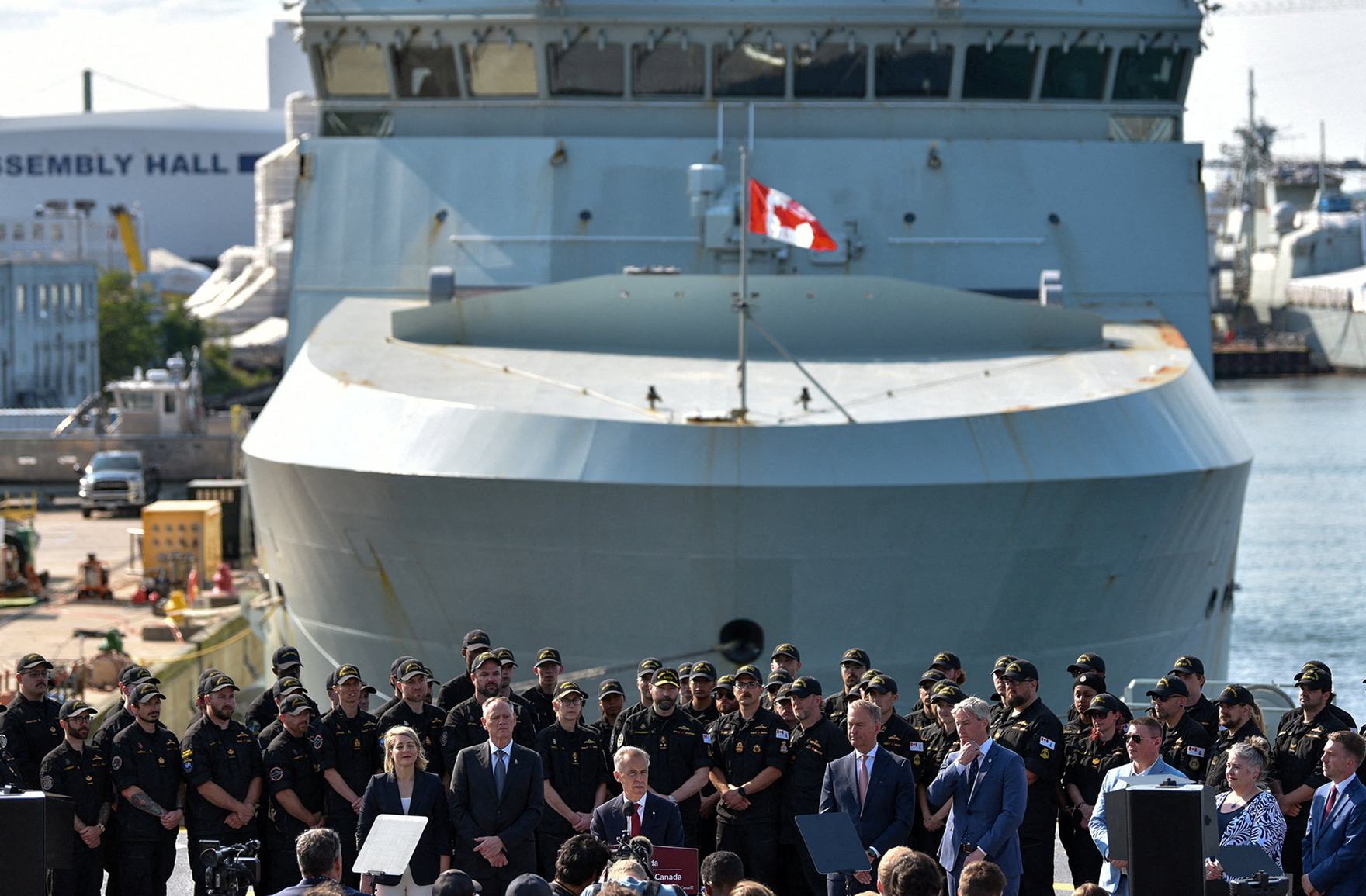
This piece was first published by the Toronto Star.
A little over two years ago, the federal government announced it would be “exploring options” for the purchase of a new submarine fleet. Last week, Prime Minister Mark Carney announced the winning bid, for up to 12 diesel-electric submarines. He did so in advance of a visit to Ankara for the NATO leaders’ summit, where the deal between Canada and the German-Norwegian consortium TKMS was exhibit A in demonstrating our commitment to increased defence spending, a contentious issue for the Trump administration.
Timely as the announcement was, it caused some awkwardness in Ankara. A planned bilateral discussion between Carney and the president of South Korea, representing the losing bidder, was abruptly cancelled. Some fence-mending will be required. Canada wants strong security and defence ties with South Korea and for the country to join the Defence, Security and Resilience bank, to be headquartered in Canada. That will mean asking Seoul to pony up a lot of investment capital.
Canada has never built submarines before and has operated few in the modern history of our Navy. “Buy Canadian” was off the table this time. When we decided against nuclear-powered submarines, we ruled out any manufacturer in the United States and were thrust into the global marketplace. The competition between TKMS and South Korea’s defence giant Hanwha Ocean, proved surprisingly tight, as both shipbuilders offered boats that met our requirements and promised massive, direct economic benefits to Canada. The German-Norwegian bid was favoured for geostrategic reasons, as it emphasizes Canada’s defence ties to key NATO allies in Europe and our shared long-term commitment to Arctic and transatlantic security.
The first new Canadian sub will be delivered by the mid-2030s, and it will be years after that before a full fleet is operational. So now that the bidding is over, it’s time we turned to some unanswered questions — about the strategic purpose of a submarine fleet and how that fleet will be networked with other defence assets to provide surveillance and deterrence.
A submarine fleet has been described as key to Canada’s coastal defence, but this is narrow and misleading. Julie Kim, a defence expert writing for the Canadian Global Affairs Institute, articulates a broader purpose: “Submarines enable Canada to detect and deter maritime threats, control its approaches, and project power and striking capability further from its shores.”
Submarines are stealth assets, built to roam the high seas, including the Arctic Ocean. They won’t be stay-at-home vessels but will combine defence and offence — although the full offensive capabilities of the TKMS sub remain shrouded in secrecy. The consortium’s fact sheet says only that it will have “heavyweight torpedoes” and torpedo counter-measures, and will be “fitted” for missiles and underwater drones.
How effective these boats will be in patrolling the Canadian Arctic is another open question. The TKMS submarine has the tonnage required to break through Arctic ice, but just barely. It seemed potentially less capable than its South Korean counterpart in turns of underwater cruising range. The Hanwha vessel is also significantly heavier than the TKMS.
What we can be sure of is that these submarines will never operate on their own. They will have to be networked into a complex web of sensors and intelligence-gathering systems that includes underwater sensors, shipboard platforms, helicopters, long-range patrol aircraft and satellite monitoring. Assembling this network will present huge opportunities for Canadian innovation — and Canadian export.
Canada’s new subs will need to be capable of operating alongside surface warships, including our Arctic offshore patrol vessels and as-yet-unbuilt fleet of River-class destroyers. Above all, our submarine fleet will need to be twinned with underwater drones, a capability the Royal Canadian Navy does not yet possess in strength. Our networked “balance of forces” should also include icebreakers: eventually, the Navy will have six patrol vessels, 15 destroyers, a small fleet of replacement coastal defence ships (also yet to be built), an undetermined number of underwater drones but only two icebreakers.
All this brings us back to the strategic purpose of submarines for Canada, which is the foundational issue here. The federal government has a decade or so to work out what that is and explain it to the public in full.
Submarines may run silent and run deep, but we need to bring the debate over their purpose for Canada to the surface.


