Whether they know it or not, Canadians rely on space for as much as 20 percent of daily economic activity in industries such as navigation, communications, banking and more. Despite that, Canada remains the only Group of Seven nation without the domestic capability to place payloads — such as the satellites that provide these services — into orbit. With space infrastructure so deeply embedded in its economy and security apparatus, yet without control of a critical piece of the delivery stack, Canada has made itself quietly dependent on the goodwill and capacity of allies. Closing that gap through sovereign launch is not simply a question about space ambitions: it is a prerequisite for a resilient space posture.
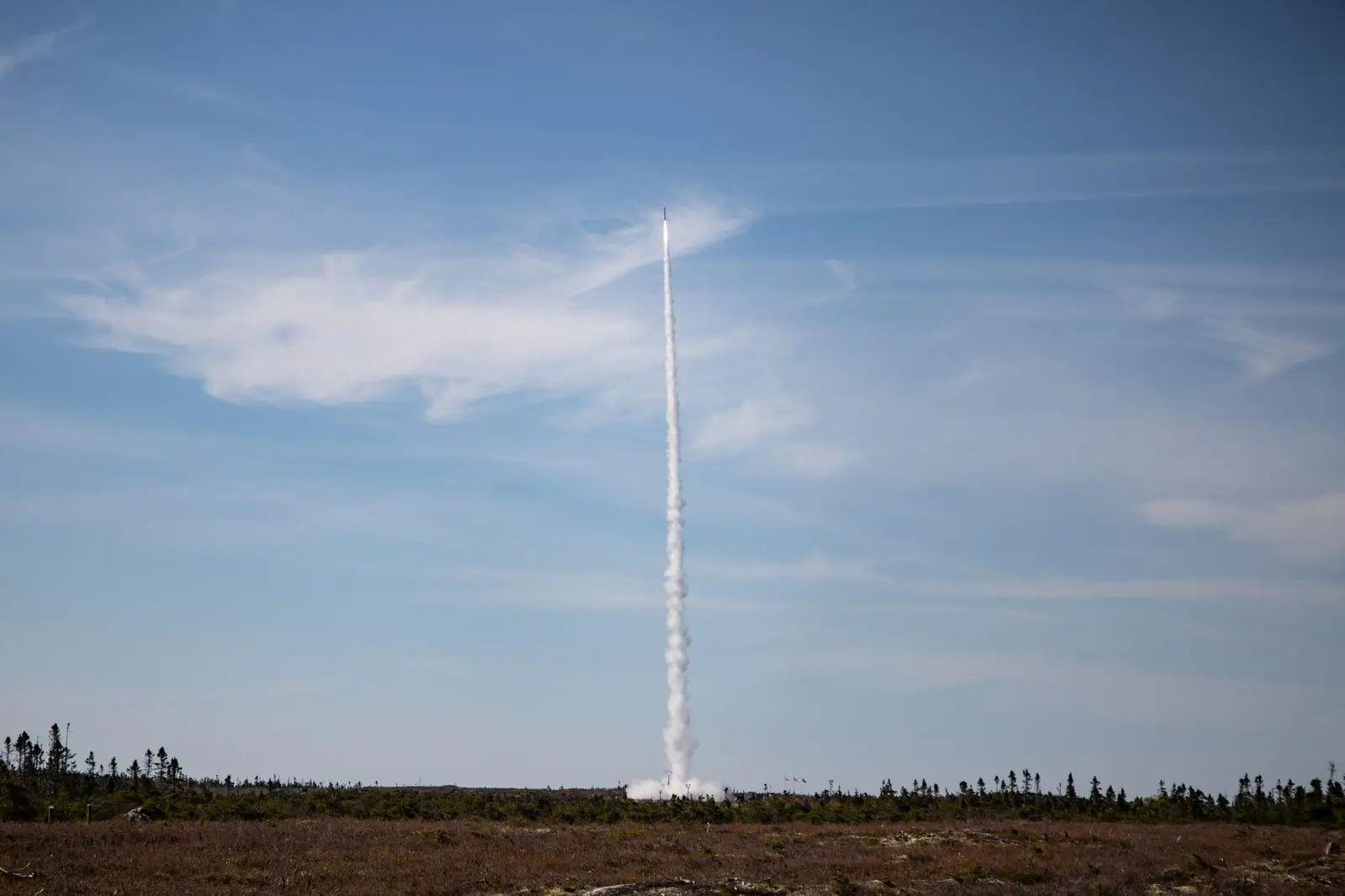
On June 10, 2026, Maritime Launch conducted a successful hypersonic suborbital test from Canso, Nova Scotia. This milestone brings Canada closer to operational sovereign launch than it has ever been. Currently, Canada relies on the Europeans and the Americans when it needs to launch equipment into space for commercial or government operations, with a waiting list that can be as much as two years delayed, even when conditions are perfect. In the words of the commander of 3 Canadian Space Division, Brigadier General Chris Horner, during an episode of the Defence Deconstructed podcast: “And so, does that mean that we should spend more hard-earned Canadian dollars to give that money to some foreign entity to launch our capability, or worse, take a bespoke military capability that has incredible military value — secret, top secret, whatever you want to call it — and give it to another country to launch for us?”
Ottawa has begun putting money behind ambition, and industry is starting to follow. A May 2026 agreement between two German companies — ThyssenKrupp Marine Systems (TKMS) and Isar Aerospace — to build Canadian launch infrastructure at Maritime Launch Services' Spaceport Nova Scotia, linked to TKMS’s winning bid for the Canadian Patrol Submarine Project, signals that sovereign launch is moving from aspiration to investment. Having our own space launch capability would be a good thing, and the Government of Canada should continue to support the goal of Canadian launch and re-entry capabilities for the stated goals of security, sovereignty and economic prosperity. These three objectives are the main talking points of both the Prime Minister’s Office and Commander Brigadier General Horner.
Over the past two years, Canada has seen a significant resurgence in interest in the space domain. Space is important for the daily lives of Canadians, and the nation already has a significant and growing space industry, including by coordinating with the United States on space domain awareness. Allies such as France, Germany, Italy and the United Kingdom all combine their launches through the European Space Agency at the Guiana Space Centre in Kourou, French Guiana.

Two important variables for Canadian launch capabilities are defence and security. Launch from Canada would provide specific orbital insertion that will give access to polar orbits for High North coverage that are harder to get to from launch facilities in Florida, California or French Guiana. At the same time, the sovereignty question will be answered because Canada will be able to launch government and commercial systems on time schedules not dependent on others. But most importantly, the opinion and argument for Canadian launch is also driven by economics.
Canadian launch from Canadian spaceports will benefit the Canadian economy in several ways. For examples, the money for manufacturing, launch and operations will remain in Canada rather than going abroad. To be sure, the upfront costs may be high, and additional financial input will be required beyond the recently allocated CDN$183 million that Ottawa has approved. However, the Canadian government’s interest and funding will demonstrate that it recognizes the importance of sovereign launch, and spur commercial confidence and investment.
Two companies are currently receiving the bulk of government funding for their efforts in establishing sovereign launch. Maritime Launch — headquartered in Halifax with a spaceport in Canso — and NordSpace — headquartered in Markham, Ontario, with its Atlantic Spaceport Complex in St. Lawrence, Newfoundland and Labrador. Following Maritime Launch’s successful hypersonic suborbital test in early June, it expects to have a fully operational, regular orbital launch within a year, while NordSpace says its is on a similar timeline for orbital insertion. Both these companies have received domestic and international commercial interest in using their launch facilities to lift satellites into low-Earth orbit. Maritime Launch will have to prove the concept, but it expects to transition immediately to commercial launch, with a growing customer list that includes prepurchased launch slots from the Canadian government and the Department of National Defence (DND).
Canadian orbital launch means that the money spent on it will remain in Canada, with the benefit of attracting domestic and foreign commercial launch money to bolster the Canadian economy. No longer will Canadian (and foreign) money flow to the United States, Russia or other launch providers for lift — that money could come to Canada instead. Additionally, rocket and satellite manufacturing and talent will stay in Canada, creating a positive feedback loop for the Canadian economy and talent retention. The Canadian space ecosystem could potentially expand from the $3.8 billion contribution to the Canadian economy (with $5 billion in revenue) in 2024, to more money for the economic prosperity cited by the prime minister and DND. Based on projections from the State of the Canadian Space Sector Report (2025), “the space sector contributed $3.8B to Canada’s GDP, which is a 6% growth since last year when adjusting for inflation, and 15% growth since 2019. This means that the sector is making an increasingly important impact on the economy at large.” These growth markers indicate the positive trajectory of the industry to the Canadian economy now and into the future. Projections are that sovereign launch from Canadian spaceports will continue to increase revenue, provide jobs, and strengthen the Canadian space ecosystem with both domestic growth and international interest and support.
With domestic launch, Canada will be able to dictate the schedules and the expansion of Canadian space networks for the benefit of Canada specifically. From new satellites — built in Canada — to an increased space presence, Canadian sovereign launch will facilitate the growth of the Canadian space ecosystem for the expansion of space capabilities. These include, but are not limited to, providing communications for the High North and connecting communities with high-speed internet, voice, data and access, as well as positive effects in education, health care and logistics. Canadian space will continue to improve customer, government and DND access to the Far North to better integrate society with services, capabilities and connectedness. All Canadians will benefit from internet access for education and health care, communications and everyday life. Launch capabilities will also bolster environmental monitoring for applications such as weather prediction and mitigation, climate science, wildfire spotting and prevention, keeping track of sea ice and shipping in the Far North, remote sensing of resources and mining, and a host of other space-based sensors for discovery and monitoring. For the DND, specifically, Canadian space access will improve Far North communications and border security, especially Arctic security, as well as oversight for Far North operations, rescue and monitoring. These improvements could include space-based bandwidth for uncrewed aerial and nautical vehicles, crewed airborne reconnaissance, and general Intelligence, Surveillance and Reconnaissance (ISR) capabilities as the Northwest Passage becomes a major shipping thoroughfare.
Most importantly, a vertically integrated Canadian space ecosystem that includes launch capabilities will ultimately boost the Canadian economy. From education to manufacturing to orbital insertion to monitoring, all the money for all the components will add to our space resilience, rather than enriching other countries. Canada has the talent and the geography, and now the political will, to close the last gap in its space posture. Sovereign launch gives Canada the final piece of the puzzle: space access that doesn’t depend on anyone else’s goodwill, schedule or politics.